
 The Ultimate Cricket Betting Exchange Guide
 2026-10-16
The Ultimate Cricket Betting Exchange Guide: How Backing & Laying Works
Cricket betting has evolved far beyond standard fixed-odds bookmaking. Modern traders and strategic bettors rely on peer-to-peer exchanges to secure superior odds, execute real-time hedging strategies, and lock in guaranteed profits before a match finishes. Understanding the mechanics of a cricket betting exchange transforms how you view live match lines, turning every boundary, wicket, and powerplay into a trading opportunity.
What Is a Cricket Betting Exchange and How Does It Work?
A peer-to-peer cricket betting exchange operates as an open marketplace where individual users wager directly against one another rather than against a centralized bookmaker. In a traditional setup, you are forced to accept prices dictated by the operator. On an exchange, market liquidity and opposing user opinions determine the prices, creating a dynamic trading environment.
Traditional bookmakers build a substantial profit margin—commonly referred to as the overround or "vig"—into every market line. An exchange does not take on risk against its players; instead, it provides matching engine infrastructure. The platform facilitates transactions between buyers ("backers") and sellers ("layers") and charges a small commission fee strictly on net market profits.
Serious traders and experienced cricket bettors prefer an official cricket betting exchange over traditional sportsbooks for several key advantages:
- Higher Odds Value: Eliminating the bookmaker's built-in margin produces odds that reflect true market probability.
- Position Management: You are never locked into a bet until the final ball; you can buy and sell positions in-play as the match unfolds.
- Unrestricted Position Sizing: As long as there is sufficient market liquidity from opposing traders, you can execute substantial trades without arbitrary account limits.
Cricket Betting Exchange vs. Traditional Sportsbook
To trade cricket effectively, you must understand how an exchange differs structural and financially from a conventional online sportsbook platform.
While a traditional bookmaker acts as the opposing counterparty on every wager, an exchange simply acts as a venue. If you want to place a trade on an exchange, another bettor somewhere in the world must take the opposing side.
| Feature / Metric | Traditional Online Sportsbook | Peer-to-Peer Betting Exchange |
| Opponent | Bet against the bookmaker | Bet against other players |
| Odds Format | Fixed odds with built-in bookmaker vig (5–12%) | Pure market-driven odds with lower margin |
| Bet Types Available | Back betting only (predicting winners) | Back (win) and Lay (lose) betting |
| In-Play Cashout | Algorithmic cashout with heavy platform haircut | Free-market trading to create a "Green Book" |
| Platform Revenue | Losses of the bettors | Small commission on net profitable trades |
Understanding Back Betting and Lay Betting in Cricket
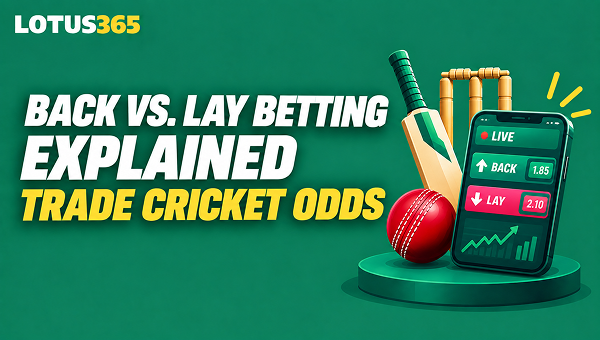
The core engine of any betting exchange relies on two fundamental actions: Backing and Laying. In exchange betting interfaces, these options are typically color-coded—Back bets are displayed in Blue, while Lay bets appear in Pink.
What Does "Backing" a Team Mean? (The Blue Box)
Backing an outcome means betting that a specific event WILL happen. This is equivalent to traditional sports betting. If you back India at decimal odds of 1.85 with a ₹1,000 stake, you win if India wins the match.
Profit=Stake(DecimalOdds-1)
Using the example above:
Profit=₹1,000(1.85-1)=₹850
Your total payout upon a successful outcome would be your original ₹1,000 stake plus ₹850 in net profit.
What Does "Laying" a Team Mean? (The Pink Box)
Laying an outcome means acting as the bookmaker by betting that an event WILL NOT happen. When you place a lay bet, you are accepting someone else's back bet.
If you Lay Australia at decimal odds of 2.10 with a ₹1,000 stake, you win the backer's ₹1,000 stake if Australia loses the match or if the match ends in a draw/tie. However, if Australia wins, you must pay out the backer's profit.
Calculating Lay Liability: The Critical Risk Formula
Before executing a lay trade, you must calculate your Liability—the maximum amount of money you risk losing if the backed selection wins.
Backer'sStake(YourPotentialWin)=LayStake
YourLiability(YourMaximumLoss)=LayStake(DecimalOdds-1)
Example Calculation:
If you decide to Lay Team B for a ₹1,000 stake at decimal odds of 3.50:
Liability=₹1,000(3.50-1)=₹2,500
- If Team B loses: You win your target profit of ₹1,000 (the backer’s stake).
- If Team B wins: You lose your liability of ₹2,500.
For an in-depth operational deep dive into managing these opposing positions, explore our comprehensive back vs lay betting guide.
How to Trade Live Cricket Odds and Lock in a Profit (Green Book)
In-play cricket markets present significant price volatility. T20 and One Day International (ODI) formats feature rapid momentum swings driven by early powerplay boundaries, middle-order partnerships, and quick fall of wickets. Exchange traders leverage these odds fluctuations to practice hedging—a technique known as creating a Green Book. A Green Book displays a positive profit figure across all possible match outcomes, ensuring a win regardless of the final result.
Step-by-Step Green Book Execution Strategy
- Initial Entry Point: Prior to the match (or following an early top-order wicket collapse), you back Team A at higher odds of 2.40 with a ₹2,000 stake.
- Scenario check: If Team A wins, your return is ₹2,800 profit. If Team A loses, you lose your ₹2,000 stake.
- Market Shift: Team A recovers via an 80-run partnership during the middle overs. As their winning probability rises, their live exchange odds drop to 1.45.
- Hedging (Laying Off): You now lay Team A at the lower odds of 1.45 to lock in profit.
- Equalizing Profit Across Outcomes: To spread your profit evenly across both teams, calculate your lay stake using the ratio of initial backing returns to current lay odds:
LayStake=InitialStakeInitialOddsCurrentLayOdds=₹2,0002.401.45₹3,310
By laying Team A for ₹3,310 at 1.45:
- Liability on Lay: ₹3,310(1.45-1)=₹1,489.50
- If Team A wins: You earn ₹2,800 from your back bet minus your ₹1,489.50 lay liability = +₹1,310.50 net profit.
- If Team B wins: You lose your ₹2,000 initial back stake, but gain the backer's ₹3,310 lay stake = +₹1,310 net profit.
By utilizing an official cricket betting exchange, you lock in an equal profit of roughly ₹1,310 before the match concludes. For advanced real-time trading methodologies, read our dedicated live cricket match odds strategy guide.
Cricket Session Markets & Fancy Betting on the Exchange
In addition to match-winner lines, exchanges popular across the Indian subcontinent feature localized session markets and fancy bets. These micro-markets refresh rapidly after every delivery.
Primary Exchange Session & Fancy Categories
- Session Runs (Over Runs): Betting on whether a team will score over or under a projected benchmark within a specific frame (e.g., 6-over Powerplay, 10-over block, or full 20-over innings).
- Lambi Pari (Total Innings Runs): Long-term innings projections where traders buy or sell total estimated team scores in 20-over or 50-over matches.
- Fall of Next Wicket (FOW): Prop betting on whether the current batting partnership will reach a defined run threshold before the next wicket falls.
- Player Performance Props: Live lines on individual milestone runs (e.g., a batsman scoring 30+ runs) or bowler wicket totals.
Market makers and algorithmic bots adjust "Yes/No" or "Back/Lay" session rates ball-by-ball. To analyze how session odds move during live broadcasts, review our explicit breakdown of session fancy betting rules or complete your Lotus 365 official login to view live match slips in real time.
Executing In-Play Bets on Mobile Without Latency
In live cricket exchange trading, execution speed is paramount. Match odds can swing dramatically in the two-second delay between a delivery being bowled, a decision being appealed, or a boundary being struck.
To trade in-play markets effectively, you need low latency and fast refresh rates. Standard desktop browsers with heavy caching or multi-tab setups can introduce lag, resulting in delayed orders or rejected trades during odds shifts.
Mobile trading interfaces designed for exchange activity minimize data transmission delays. Features built for active traders include:
- One-Tap Execution: Bypassing multi-step confirmation screens to place orders instantly when prices reach target values.
- Biometric Authentication: Secure login protocols via fingerprint or facial recognition for rapid session access.
- Live Visualizers: Dedicated, lightweight data feeds providing ball-by-ball updates directly within the order ticket interface.
For optimal performance on mobile devices, download the Lotus 365 app to access real-time trading tools with minimal connection latency.
Bankroll Discipline & Common Mistakes to Avoid
While betting exchanges offer greater flexibility than traditional bookmakers, improper risk management can quickly deplete your account. Novice traders should watch out for these four common pitfalls:
- Uncapped Lay Liabilities: Laying high long-shots (e.g., laying an outsider at 15.0 or 20.0 decimal odds) without calculating your liability beforehand. A ₹1,000 lay bet at 20.0 odds carries a massive ₹19,000 liability to win just ₹1,000.
- Chasing Losses In-Play: Increasing trade stakes mid-match after a failed session call. Emotional trading during unpredictable middle overs often leads to compounding losses.
- Ignoring Market Liquidity: Placing orders in under-capitalized or minor-league markets where your stake sits unmatched due to a lack of counterparty interest. Always trade high-volume markets with deep liquidity.
- Failing to Account for Exchange Commission: Forgetting to factor in commission fees on winning trades when calculating target profits and hedging ratios.
Frequently Asked Questions About Cricket Betting Exchanges
What happens if my cricket exchange bet is unmatched?
If there is insufficient opposing market liquidity when you place your order, your trade remains in an "unmatched" state in the order queue. It will stay pending until another bettor accepts your odds, or it will automatically cancel when the market closes at the end of the innings.
Is lay betting riskier than back betting in cricket?
Lay betting is only riskier if executed on high decimal odds without proper bankroll calculations. Laying short-priced favorites (e.g., laying a team at 1.25 odds) carries relatively low liability relative to your potential return.
How is commission charged on a cricket betting exchange?
Commission is deducted exclusively from your net market winnings. If you end a specific market session with a net loss or a zero balance, no commission is charged on those transactions.
Can I bet on live ball-by-ball overs on the exchange?
Yes, live session and fancy betting markets update after every delivery. This allows you to back or lay run lines, boundaries, and wicket events in real time as the match progresses.
Looking to explore active exchange markets or review updated odds? Visit the main platform hub at Lotus 365 to view active cricket fixtures and live market liquidities